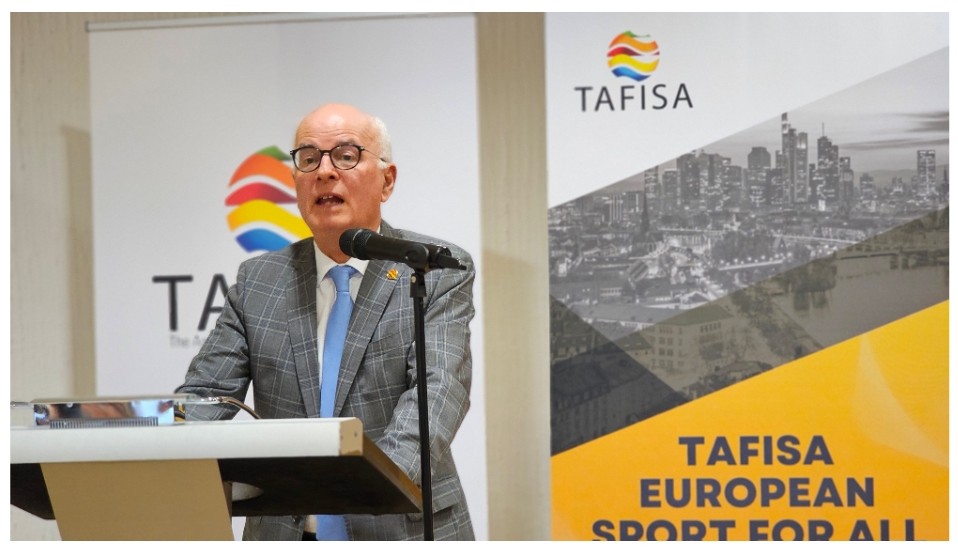
Opinion: «Sport for All: A Movement More Relevant Than Ever» – Wolfgang Baumann, TAFISA President
May 2, 2025.
What the Sport for All Movement represents, what we all represent, is something that does not exist elsewhere. Sport for All is unique in that it can take place in many forms and shapes, and in a diversity of structures, contexts, and frameworks. In Germany, for instance, we are fortunate to have a strong foundation of sport federations, clubs, and gymnastics associations that provide daily opportunities for millions. But we cannot ignore a growing reality: more and more people are moving outside these traditional systems. They are being active in public spaces, at home, in commercial gyms, or even through self-organised communities. The modes of participation are changing, and we must change with them.
Under the umbrella of Sport for All, we are bringing together all these different ways people can enjoy sport and physical activity, whether structured or unstructured, in a club, in a school, or self-organized, alone or with friends. We live in times where, on the one hand, globalization has standardized a lot of things, but on the other hand, the internet and social media have allowed people to find their own, less mainstream communities, and explore new hobbies. We are no longer in times where everyone was listening to the same top music hits, or following the same one or two sports, because we did not hear about anything else – people now have access to a lot of information and knowledge. The model that worked and made sense twenty years ago is no longer adapted to modern lifestyles.
But this also marks the trend of a more polarized world. We can see how, as people find their niche and delve into their communities, something that might seem positive at first, can also have harmful consequences. People increasingly tend to stay in echo chambers, communities where everyone shares the same opinion or political ideas, which makes dialogue harder and creates conflicts.
In this respect, Sport for All presents several advantages. First, we do not need to impose one way for people to be active and participate in sport activities. Sport for All embraces and welcomes all, and this includes the diversity of Traditional Sports and Games as well as new modern sports, all of which can appeal to individuals differently and attract new populations to be active. Secondly and more importantly, Sport for All has a proven track record in its ability to bring people together regardless of their differences. In the uncertain times the world is currently facing, Sport for All can represent a great asset for society to come together as one. One could say that Sport for All is nowadays more relevant than ever, and yet it is in dire need of support.
Our ecosystem is fragile. Especially as we face challenging times, sport can often appear as less of a priority despite the countless benefits it can bring us. As such, we must show solidarity, not just in helping each other, which of course is also relevant, but in standing together as one. The times when we could afford to each work independently are now over. If we want to have an impact and if we want to build a strong case for the relevance of the work we are doing, we need to act collectively. This includes ensuring that we all recognize the importance and relevance of every actor and stakeholder that makes the Sport for All community, from national and international organizations to grassroots and community movements.
The European Sport Model affirms the importance of solidarity, and those principles are essential for the survival of Sport for All. But it is not enough to acknowledge this in theory; it must be translated into practice. That means ensuring that grassroots and local organizations receive the recognition as well as the support they need to continue delivering meaningful change. With the European Union preparing its next 7-year cycle for the Multiannual Financial Framework (MFF), now is the time to reinforce the place of sport, especially Sport for All, on the political and funding agenda. We need to safeguard the EU Sport Policy and enable sport to continue playing its vital role to promote health, wellbeing, and peace in Europe. The European Commission plays an essential role in providing us with the policy framework to do our work. And it is important that we not only recognize that but also engage in this process and let our voice be heard. If the EU has a key role to play through the EU Sport Policy, we also must ensure we do our part and share our feedback, insights, concerns, and thoughts with the EU.
We also often talk about the values and benefits of Sport for All, from social inclusion and gender equality to peace, education, health, and wellbeing, among many more. But it is important to keep in mind that these do not happen automatically just because “sport” happens. It is complex to design a program to achieve a realistic and measurable impact. The implementation of Sport for All programs and initiatives requires resources, both financial and human, but also a specific set of knowledge, skills, and expertise to effectively achieve their objectives. This is why we have been investing so much in capacity building. We believe in empowering the actors of Sport for All, from volunteers and coaches to sport managers and directors, as well as any organisation working with Sport for All, so that they can have a greater positive impact on the people they serve and their communities.
To conclude, I believe we all agree that Sport for All can have an even greater positive impact on the world. And in the troubled times we are currently in, I would say that this is no longer a luxury; we need Sport for All to help and contribute to a better world. Everyone has a role to play to make it happen, from international organizations and intergovernmental institutions to the community, grassroots NGOs. But we need to keep in mind that collective action will not happen on its own; it needs to be intentional, it needs to be principled, and we need to proactively seek cooperation and strive to work together.
Wolfgang Baumann
TAFISA President
_______________________________________________________________________
 Opinión: «Deporte para Todos: Un Movimiento Más Relevante que Nunca» – Wolfgang Baumann, Presidente de TAFISA
2 de mayo de 2025.
Lo que representa el Movimiento Deporte para Todos, lo que todos representamos, es algo que no existe en ningún otro lugar. El Deporte para Todos es único, ya que puede desarrollarse de diversas formas y modalidades, y en una diversidad de estructuras, contextos y marcos. En Alemania, por ejemplo, tenemos la suerte de contar con una sólida base de federaciones deportivas, clubes y asociaciones de gimnasia que brindan oportunidades diarias a millones de personas. Pero no podemos ignorar una realidad creciente: cada vez más personas se alejan de estos sistemas tradicionales. Se mantienen activas en espacios públicos, en casa, en gimnasios comerciales o incluso a través de comunidades autoorganizadas. Las formas de participación están cambiando, y debemos adaptarnos a ellas.
Bajo el paraguas de Deporte para Todos, unimos todas estas diferentes maneras en que las personas pueden disfrutar del deporte y la actividad física, ya sea estructurada o no, en un club, en una escuela o de forma autoorganizada, solos o con amigos. Vivimos en una época en la que, por un lado, la globalización ha estandarizado muchas cosas, pero por otro, internet y las redes sociales han permitido a las personas encontrar sus propias comunidades, menos convencionales, y explorar nuevas aficiones. Ya no vivimos en tiempos en los que todos escuchaban los mismos éxitos musicales ni seguían los mismos deportes por desconocimiento; ahora las personas tienen acceso a mucha información y conocimiento. El modelo que funcionaba y tenía sentido hace veinte años ya no se adapta a los estilos de vida modernos.
Pero esto también marca la tendencia hacia un mundo más polarizado. Podemos ver cómo, a medida que las personas encuentran su nicho y se integran en sus comunidades, algo que al principio podría parecer positivo, también puede tener consecuencias perjudiciales. Las personas tienden cada vez más a permanecer en cámaras de resonancia, comunidades donde todos comparten la misma opinión o ideas políticas, lo que dificulta el diálogo y genera conflictos.
En este sentido, el Deporte para Todos presenta varias ventajas. En primer lugar, no necesitamos imponer una única forma de ser activos y participar en actividades deportivas. El Deporte para Todos abarca y da la bienvenida a todos, incluyendo la diversidad de deportes y juegos tradicionales, así como los nuevos deportes modernos, que pueden atraer a personas de forma diferente y a nuevas poblaciones a la actividad. En segundo lugar, y más importante, el Deporte para Todos tiene una trayectoria comprobada en su capacidad para unir a las personas independientemente de sus diferencias. En los tiempos de incertidumbre que enfrenta el mundo, el Deporte para Todos puede representar un gran activo para la unión de la sociedad. Se podría decir que el Deporte para Todos es hoy más relevante que nunca, y sin embargo, necesita urgentemente apoyo.
Nuestro ecosistema es frágil. Especialmente en tiempos difíciles, el deporte a menudo puede parecer menos prioritario a pesar de los innumerables beneficios que puede aportarnos. Por ello, debemos mostrar solidaridad, no solo ayudándonos mutuamente, lo cual, por supuesto, también es relevante, sino manteniéndonos unidos. Los tiempos en que podíamos permitirnos trabajar cada uno por separado han quedado atrás. Si queremos tener un impacto y fundamentar sólidamente la relevancia de nuestro trabajo, debemos actuar colectivamente. Esto implica asegurar que todos reconozcamos la importancia y relevancia de cada actor y parte interesada que conforma la comunidad del Deporte para Todos, desde las organizaciones nacionales e internacionales hasta los movimientos de base y comunitarios.
El Modelo Europeo del Deporte afirma la importancia de la solidaridad, y estos principios son esenciales para la supervivencia del Deporte para Todos. Pero no basta con reconocerlo en teoría; debe llevarse a la práctica. Esto implica garantizar que las organizaciones de base y locales reciban el reconocimiento y el apoyo que necesitan para seguir generando cambios significativos. Con la Unión Europea preparando su próximo ciclo de 7 años para el Marco Financiero Plurianual (MFP), ahora es el momento de reforzar el lugar del deporte, especialmente del Deporte para Todos, en la agenda política y de financiación. Necesitamos salvaguardar la Política Deportiva de la UE y permitir que el deporte siga desempeñando su papel vital en la promoción de la salud, el bienestar y la paz en Europa. La Comisión Europea desempeña un papel esencial al proporcionarnos el marco político para realizar nuestra labor. Y es importante que no solo lo reconozcamos, sino que también participemos en este proceso y hagamos oír nuestra voz. Si la UE tiene un papel clave que desempeñar a través de la Política Deportiva de la UE, también debemos asegurarnos de cumplir con nuestra parte y compartir nuestros comentarios, perspectivas, inquietudes y reflexiones con la UE.
También hablamos a menudo de los valores y beneficios del Deporte para Todos, desde la inclusión social y la igualdad de género hasta la paz, la educación, la salud y el bienestar, entre muchos otros. Pero es importante tener en cuenta que estos no se producen automáticamente por el simple hecho de practicar deporte. Es complejo diseñar un programa para lograr un resultado realista y medible.